Escape to New York by Richard Otter [Comp05]

IFDB page: Escape to New York
Final placement: 11th place (of 36) in the 2005 Interactive Fiction Competition

I had to swim through some choppy technical waters to even get to this game. Apparently ADRIFT’s latest version isn’t backwards-compatible with games generated by previous versions, or at least it didn’t appear so — the interpreter squawked something about generator libraries at me, giving me an instruction it wasn’t capable of letting me carry out. (I’m guessing the instruction was for authors?) So back I went to a previous version, which required a full windows install and when run complained about how it didn’t have the right permissions to update the registry (surely something the installer could have taken care of?) Anyway, I fought through that — let’s chalk it up to me trying to play this game 16 years after it was released, and move on.

Escape to New York has an intriguing albeit somewhat odd premise. You play a thief who has boarded the Titanic. Now, the game is extremely coy about actually acknowledging the fact that you’re on the Titanic — the name isn’t mentioned anywhere in any of my game transcripts or the supporting materials. In the game, it’s just a big fancy ship that happens to leave Southampton for New York on April 10, 1912. Oh, and it also sinks. Hey, just like the Titanic! I’m not sure why the game is so reluctant about naming the ship — you can even find a pamphlet that tells you a million facts about it (perhaps somewhat anachronistically expressed in metres and metric tons?]… but not the ship’s name. A strange choice. Another strange choice: it names its protagonist “Jack Thompson”, which is really awfully close to Leonardo DiCaprio’s “Jack Dawson” from the massively popular 1997 film. Why?

In any case, placing the PC on the Titanic creates a weird sense of dramatic irony — we know the ship’s going to sink, but he doesn’t, and therefore it’s a little odd to be running around trying to liberate loot from the passengers on a ship you know is doomed. Apparently the game’s idea of a successful run is to steal as much as possible and make it to a lifeboat, but it’s not clear from the outset that this is your goal. I kept expecting a big twist to happen where suddenly you forget about being a thief and just try to make it out alive, but nope. The game’s insistence on petty goals when the player knows a life-or-death situation is coming made for an offputting dissonance.

The other offputting part is the underimplementation. Some aspects of the game are quite lovingly crafted — it provides lots of good descriptions and creates a fine sense of place, but just as often it frustrated me with its seemingly arbitrary requirements and boundaries. For example, the first section of the game requires you to wander around the ship’s corridors until you find the mailroom. Fair enough, but sometimes travel directions are closed off with the message, “Something tells you that wandering around the corridors of the ship is not the best use of your time.” Well, maybe not, but it certainly is what the game requires! You can’t succeed without doing that, so “something tells me” the PC’s intuition is a little off in that regard.

There are also several learn-by-dying or learn-by-undo puzzles scattered throughout the game. You might enter a room in which someone suddenly pounces on you based on something you’re wearing or carrying, with no warning whatsoever. In another section of the game, you require a disguise to get past a watchful policeman. The only ways to get through this are to either try it and fail with a game-ending message, or to finally acquire enough disguise-ish items that the game tells you, “That lot should make a good disguise.” Mind, it’s given messages before about individual items, saying that they’d make a good disguise on their own, only to snatch the rug out when you try to actually use them. It seems to me that if the PC is capable of assessing how complete a disguise needs to be, he should also be capable of assessing whether or not to assay an attempt at passing a policeman with an incomplete disguise, but the game provides no such internal monologue.

At some point I got annoyed enough with this bait-and-switch behavior that I switched over to using the walkthrough, and once I did I started having a reasonably good time. For one thing, it helped me understand what sort of playthrough the game had in mind — run around gleefully nicking stuff and stuffing it in a suitcase, so that you can escape to boat with your big prize (a stolen painting you connived to get into the mailroom) and a bunch of other loot as well. Strip away the historical scaffolding and it’s essentially a Zorky treasure hunt, albeit with far less clever puzzles — you mostly get stuff via LOOK ON [object] or LOOK UNDER [object].

I also found myself really appreciating ADRIFT’s autocomplete feature, which surprised me a bit. I’m sure it’s been at least 15 years since I played an ADRIFT game, and having recently reposted all my previous comp reviews, my memories of it are not kind. This time, though, I enjoyed the way that its autocomplete let me type just one or two letters of verbs and nouns, really smoothing the playing experience. It was also a useful (though not entirely reliable) way to see if the game had implemented something — it yielded some false negatives, but if you saw it autocomplete something, you knew it was in the game somewhere. It did have a downside, sometimes anticipating nonsensical input and leading me to accidentally enter commands like “put parcel in baggage slip” when I meant “put parcel in bag”, but overall it was a feature I found myself wishing were in other games.

Overall this was a pretty flawed game, with mild issues in premise, writing, and implementation, but once I allowed myself the walkthrough I found it fairly enjoyable, and I appreciated the chance to be in a story that takes such an unusual approach to the hoary set-piece of “You are on the Titanic.” Once I knew it was a treasure hunt, I could gleefully romp through the ship ripping off valuables, in hopes that me, my giant suitcase, and my stolen painting could end up safe on a lifeboat while the rest of my luckless fellow passengers scrambled for their mere lives.

Rating: 7.4

PAX East Part 4: Saturday They’ll All Be Back Again [Misc]

[I originally posted this on my other blog, >SUPERVERBOSE, way back when it was on livejournal. It’s the fifth in a series of posts about my visit to PAX East 2010, which was life-altering in a good way. I’ve cleaned up the text ever-so-slightly and the links ever so much more.]
*************************
Compared to Friday, Saturday was pretty low-key. Then again, it’s not fair to compare anything to Friday. I let my exhausted self sleep in, then showered, packed up, etc. I met my friend Ruth Atherton for lunch, along with her partner Yigal and their adorable boy Natan. I’ve known Ruth since our freshman year of college at NYU — over 20 years ago now! — and it was wonderful to spend some time with her again.

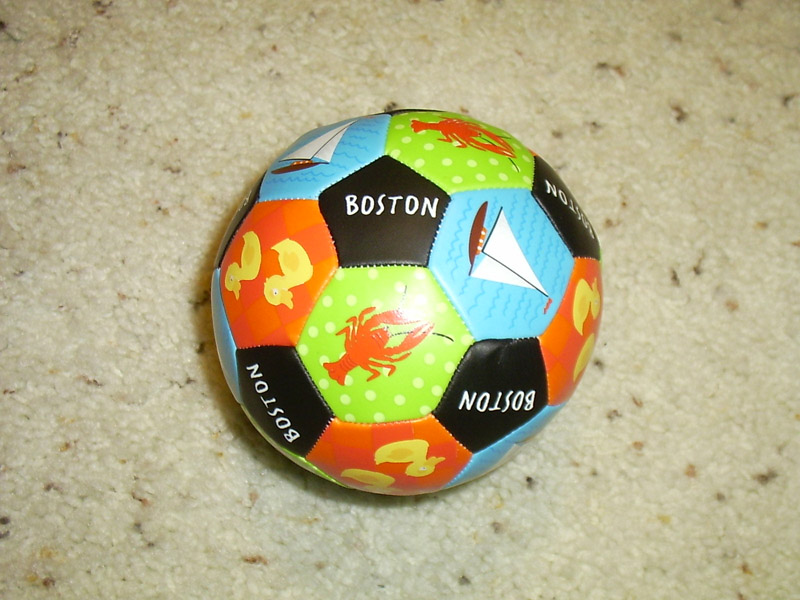
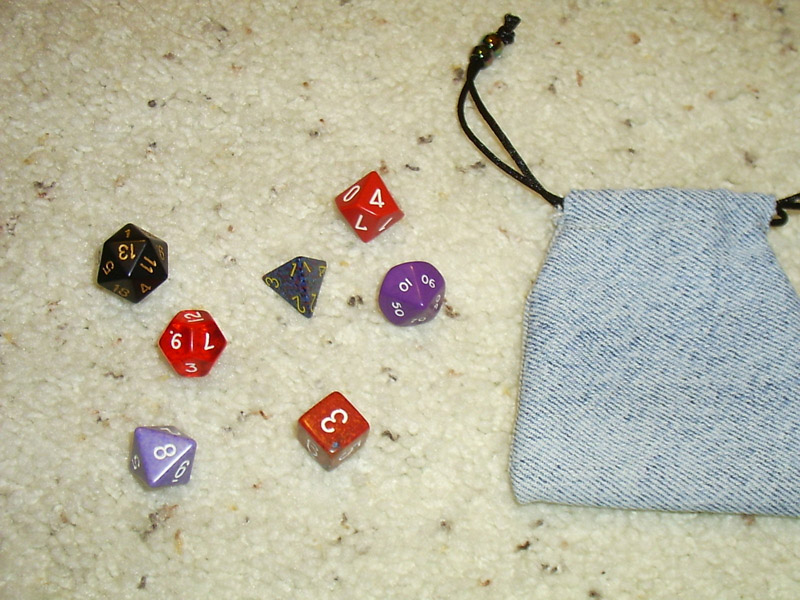
Ruth dropped me at the Hilton, and I stopped into the IF Suite, where the PAX SpeedIF efforts were well underway. I opted out, given that 1) I didn’t bring my laptop to the suite, 2) it’s been years since I actually wrote any IF code, and 3) I didn’t want to spend my PAX time heads-down coding anyway. So it was off to the convention center, where I undertook my next mission: a present for Dante! I checked out a Boston souvenir store in the Prudential Center and picked up a cute little Boston ball, to use as a backup if I couldn’t find anything in PAX itself. But I did — his own bag of dice. He’s often wanting to play with my dice, so now he’s got his own. (He was quite delighted with these gifts when I brought them home, and as he often does, he immediately turned it around on me. “Pretend that you are Dante and I am Daddy! Dante, I brought you some presents! A Boston ball, and your very own bag of dice!”)

After a quick trip to Trader Joe’s for some trail mix and water, I took the time to explore the rest of PAX, but between the incredible crowds and my own lack of motivation, I didn’t really hook into anything. I wasn’t up for boardgaming with strangers, nor did I fancy standing in line for a chance at console, PC, or handheld games. And of course the panels were out of the question — you had to arrive at least 30 minutes early to have a crack at getting into any panel, and none of the panels at that time were terribly interesting to me anyway.

So back to the IF suite I went. I hung out and chatted with various people, and even skipped dinner so that I could spend more time in the ambiance. (That’s where the trail mix comes in.) There were a few people I missed — I would have loved to hang out with Stephen and Rob a bit more, for instance — but I really enjoyed the various people I talked to. I think part of the connection-missing may have had to do with the fact that while I have a cell phone, it is a creaky 2005 pay-as-you-go model with no internet access and the clunkiest of texting capabilities. Normally, this does not bother me at all, but sometimes during PAX weekend I felt like an timebound mortal in a Kage Baker Company novel, looking on in blissful ignorance while all around me the immortals communicate telepathically. It probably also wouldn’t hurt to hang out on ifMUD more than once every two years.

All part of the thawing process, I suppose. While I wasn’t musing on that, I also kept an eye out for newbies and visitors. I hooked several people up with IF swag and talked to them about the medium and the community, which felt great. Extended social exertion like that is a bit out of my comfort zone — I’m an introvert by nature — but I liked helping with the IF outreach mission.

That mission was the subject of the informal panel at 7:00. That panel featured Andrew Plotkin, Jason McIntosh (aka jmac), Chris Dahlen (gaming journalist), and John Bardinelli (of JayIsGames). It was moderated, in an endearingly prolix style, by Harry Kaplan. (I should mention here that Harry was quite helpful in getting me connected with the pre-PAX discussion, and was particularly welcoming to me in the suite. Also, he’s apparently the cousin of Paul Fishkin, who founded Stevie Nicks’ record company! Remote brush with fame!) Harry would make a discursive, intentionally provocative statement, and ask the panel to respond, offering the lead to a different panelist for each question. The discussion often expanded beyond the panel and into the room, which was great, because the room was packed (seriously, packed) with very smart people.

I am terrible at reconstructing discussions, so I’m not going to try to do it here. Much. I will say that I was particularly struck by the way Emily framed the problem of IF’s learning curve. The parser, she said, makes a false promise, strongly implying by its openness that it is able to handle anything the player throws at it, which is simply not true. Lots of people would like to see IF respond by expanding the range of actions and phrasings that the parser can understand, but Emily disagrees. She could do a much better job than I of articulating this, and probably does so somewhere, but essentially she argues that expanding the parser is a blind alley, because it never eliminates the false promise issue, and creates a ridiculous implementation headache. Even if the game could legitimately understand a much wider range of commands, coding meaningful responses to that radically expanded command set is a misuse of our energies. Instead, she suggests that we embrace IFese while finding ways to help games gently nudge players in the right direction when it seems that they’re struggling to speak IFese to the parser. She did some work toward this in City Of Secrets, and Aaron Reed apparently does even more in Blue Lacuna. She points to Façade as a cautionary example of what happens when you try to go the other direction.

After the panel, there was a bit more chatter, and then it was time to for SpeedIF contestants to turn in their games. I had no laptop, but Juhana Leinonen very kindly let me use his to play Sarah Morayati’s Queuelty, which I found quite enjoyable.

More chatting, more hanging out, but eventually, sadly, it was time for me to go. There would be more events on Sunday, but my flight left early Sunday morning — I hadn’t wanted to take undue advantage of Laura’s generosity with the childcare, so I kept my trip to two days. I’m sorry to have missed Sunday, though. From what I read [in a livejournal that has since been deleted and purged, even from the Wayback Machine — 2022 PO], it was great.

The rest is uninteresting travel details, except for this revelation, which traveled home with me: it has become painfully, unmistakably clear that working every night and weekend is ruining my life and blocking me from doing the things that actually make me happy. The truth is that nobody ever told me to do that (well, with some exceptions) — it’s just that I’m so overwhelmed all the time, so behind all the time, that I feel like I have to do that in order to have a remote chance of success at work. But keeping my head above water there has come at the cost of drowning the parts of myself I treasure more. So I’m going to stop doing that.

I’m going to try, anyway. It’s rather shockingly hard to draw firm boundaries around work when they’ve been obliterated for so long. I’m taking it one day at a time. I’m on Day 6 now, and even in the last week I’ve been able to produce these blog entries, which would have seemed ridiculously out of reach a few weeks ago. That makes me happier than I’ve been in quite a while.

PAX East Part 3: Do You Like Movie? [Misc]

[I originally posted this on my other blog, >SUPERVERBOSE, way back when it was on livejournal. It’s the fourth in a series of posts about my visit to PAX East 2010, which was life-altering in a good way. I’ve cleaned up the text ever-so-slightly and the links ever so much more.]
*************************
In the afterglow of the panel, intentions were formed in the direction of dinner. Boston residents Dan Schmidt and Liza Daly kindly guided us to a fabulous sushi restaurant: Samurai. Delicious food, wonderful company, beer — what’s not to love? Only one thing, it turns out: the place was too small to accommodate the 12 of us at one table, so Emily, Rob, Dan, and Liza ended up at their own table beyond earshot of ours. And we got split up just as I was in mid-sentence with Emily: “I think some topics that didn’t get touched in the storytelling panel were–”

(For the record, the rest of the sentence was “integrating hints adaptively into the story in a way that feels seamless, and exploring PC emotion — how and whether to convey it.”)

After dinner, we paid the check (or rather, Stephen paid the check and we paid Stephen) and headed back towards the convention center to get in line for GET LAMP! Then, confusion ensued as we realized we’d inadvertently left behind Christopher Huang and Sam Kabo Ashwell. We went back, they weren’t there, we milled, we shivered, we went back to the convention center and found that they were in line ahead of us. It was like a French farce, only huge and freezing cold.

Anyway, we hung out in line for a while, then made our way into the “theater” — really just another convention center room with a projection screen set up. We got seats in the back, but the point is: we got seats. Others in the room ended up against the walls, on the floor, etc. There weren’t enough chairs, but everybody got into the room, which is a decidedly good thing. Jason was contemplating a second showing if they’d had to turn people away, but that showing would have started around midnight.

And now, a discursive aside about GET LAMP. About four years ago now (actually, now that I look at it, exactly four years ago today [“today” in this case being April 2, 2010, the day I originally posted this piece –2022 PO]), I got an email from somebody I’d never heard of, a guy named Jason Scott. He claimed to be a filmmaker, working on a documentary about IF. He wanted to know if he could interview me. I checked out the website, and he looked legit — for one thing, he’d already completed one such project, a huge multi-episode docu about BBSes. So I told him I’d be delighted to talk IF with him sometime.

Then, nothing until January of 2007, when I suddenly got notice that Jason would be in town in a few weeks, and did I still want to be interviewed? I sure did, so on a snowy Saturday night we met inside my deserted workplace (this was back before everybody at my job was working weekends) along with Robb Sherwin (who was apparently the guy who gave Jason my name — thanks Robb!) and his girlfriend Dayna. Jason set up his camera and asked questions. I blathered for 90 minutes, wondering if any of this was remotely usable. Then Jason took us out to dinner at an excellent French restaurant. All in all, not a bad night at the office.

Jason interviewed a bunch of other people throughout 2007, and then GET LAMP seemed to go dark for a while. Work continued sporadically, but it was hard to see what the endpoint would be. But last year it caught fire again. Jason lost his job and rather than look for another one, he ran a Kickstarter project to raise $25,000, and damned if he didn’t do it, and even go beyond. To me, that was a huge statement about the confidence and trust he’s built in the community of people around him. He used the money to pay living expenses while he finished GET LAMP, with the result that he was able to premiere it at PAX East. What he showed wasn’t the final cut of the movie, but rather a 70-minute “mix” tailored to the PAX audience. The whole shebang is going to be a 2-DVD set, with boatloads of bonuses, games (including my own), and even a branching path at one point in the movie. Heh. He’s sending me a copy, because I was an interviewee — a very classy move, according to me.

So that brings me back to PAX. What I can say about the movie I saw is this: I loved it. Yes, there were a few pieces that needed some technical polish, and a couple of spots that made me cringe a bit, but overall, WOW. It conveys what’s special about IF with such passion and cleverness, and it brings in some angles that feel fresh. It’s touching, it’s funny, it’s very effective at conveying information, and it’s quite entertaining. Also, it’s 70 minutes of very smart people discussing something about which I care deeply, so it’s pretty much made for me.

Top 5 terrific things about GET LAMP

1. Egoboo. Yes, okay? It was quite gratifying to see myself managing to speak somewhat coherently about IF in the clips that featured me, and I felt quite honored to be placed in a context alongside people whom I hold in very high esteem.

2. Insight. A lot of thoughtful people had a lot of thoughtful things to say. Some of them I’ve heard a thousand times already, but they’d feel fresh to somebody for whom this was a new subject. Others felt fresh to me too. One example that sticks out: Jason Shiga observing that when you’re a kid, you don’t get to make a lot of choices. You don’t decide where to live, where to go to school, how to spend much of your time. When you’re in that situation, having a game offer you control of the story you’re in can be a very satisfying feeling indeed.

3. The section on blind players. Jason very astutely taps into the subculture of blind IF players, for whom this is one of the only feasible genres of computer game available. One of his subjects, Michael Feir, was somebody I kept in contact with when I was editing SPAG. Michael was the longtime editor of Audyssey, a gaming zine for the blind. Anyway, this section of the film had some wonderful pieces to it. I loved the woman who observed that one of the skills IF helps you build is mental map-making, and suggested that playing IF has made her more confident when she’s exploring an unfamiliar place. And Austin Seraphin is great, cracking that when a game tells him, “It’s pitch dark. You can’t see a thing,” he just thinks: “So what does that matter?”

4. Infocom. Dave Lebling, Steve Meretzky, Mike Berlyn, Stu Galley, Marc Blank, Brian Moriarty, Amy Briggs, et cetera. These names lit up my teen years so much they may as well have been rock stars. This movie had fantastic footage of each of them, telling great stories from the company’s heyday and offering perceptive opinions about the form in general. What a pleasure it was to see their faces, hear their voices, and get to know them a little better.

5. Explanatory power. I am very, very accustomed to getting befuddled stares when I talk about interactive fiction. I love that such a compelling visual text exists, that can introduce the subject to somebody new with both the intellectual clarity and the emotional weight it deserves. I’m very hopeful that it’ll bring a fresh wave of enthusiasm into the IF community itself, and that I can use it with my friends and family to shed some light on my ongoing fascination.

The best part of all, though, wasn’t so much the film itself as the moment it created. Jason sums it up: “this had, by dint of using my film as the stone in the stone soup, become the largest assembly of interactive fiction folks in history. Creators, players, and legends were going to assemble on PAX East, and make it something very, very special.” That’s exactly what happened, and nothing exemplified it more than the panel after the film:

* Dave Lebling (Zork, Enchanter, Spellbreaker, The Lurking Horror)
* Don Woods (Adventure, need I say more?)
* Brian Moriarty (Trinity, Beyond Zork, Wishbringer)
* Andrew Plotkin (So Far, Spider And Web, Shade)
* Nick Montfort (Twisty Little Passages, Ad Verbum, Book And Volume)
* Steve Meretzky (A Mind Forever Voyaging and so many other great games that just the thought of typing them out exhausts me.)

Again, Jason will release the footage at some point, so I’m not going to try to recap the panel. Suffice it to say that it was an unbelievable confluence of talent and history, a great discussion of IF, and oh by the way Meretzky is FREAKING HILARIOUS. Stephen later asserted that Steve Meretzky must be on every panel, everywhere, from now on. I quite agree.

After the film, I got to shake the hands of some legends and thank them for the huge positive impact on my life. We toddled on back to the suite, buzzing. The conversation there felt infused with joy; it glowed in the dark.

It’s hard to explain what this day meant to me. It was one of the best days I’ve had in years and years. Jason said to me later, “This weekend is like one big hug for you, isn’t it?” He’s not wrong. It was emotional, even more so than I expected, to be a part of this gathering — Rob called it the “IF Woodstock.” I tried to say so in the suite, though I’m not sure how articulate I was. I felt filled with love, for interactive fiction, for the IF community, and specifically for these people who shared this experience with me. It was vivid, elevating.

After the party broke up, I grabbed a taxi back to my hotel (the T had long since closed), and before I went to bed, posted this on Facebook:

Back when I was active in the interactive fiction community, and also going to conferences for work, I used to daydream about an IF conference where we’d have bunches of key people from the past and present, panels about various aspects of the form, face time with all these people I just knew as words on a screen, etc…. Today said: “I’ll see your dream, and raise you an IF movie!”

PAX East Part 2: There’s More At The Door [Misc]

[I originally posted this on my other blog, >SUPERVERBOSE, way back when it was on livejournal. It’s the third in a series of posts about my visit to PAX East 2010, which was life-altering in a good way. I’ve cleaned up the text ever-so-slightly and the links ever so much more.]
*************************
After some suite chat, 2:00 rolled around, which was the time PAX was officially supposed to open. So a large contingent, myself included, headed con-wards. My first and most lasting impression of PAX is: PEOPLE. People, people, and also, more people. Behind them are other people, who block your view of the people already inside, and if you turn around, you can see a long line of people, stretching back farther than you can see. I feel like if I’d missed my plane, I could probably have walked a couple of blocks from my house in Colorado and gotten in line for the PAX keynote with Wil Wheaton. Good lord, there were a lot of people.

Serious luck was on my side, as I had Rob Wheeler along to act as my Virgil through the utterly overwhelming and confusing human ocean that was the PAX entrance. He’d attended the Seattle PAX the previous Fall, and had also scoped out the scene beforehand to pick up his Speaker badge. (More about that later.) He helped me navigate my way into a long entrance queue, along with Sarah Morayati, a very friendly (and talented, I later discovered) woman who came on the scene in the last few years.

Meeting Sarah was my first taste of a feeling that was to get very familiar over the next couple of days. I am, I discovered, Unfrozen Caveman IF Guy. It’s as if I’ve been in suspended animation for the last five years, and I thawed out at PAX, like Captain America looking up at the Avengers and thinking, “Who are you guys?” When Dante was born in 2005 (and really, a little before, as we were preparing for his arrival), I withdrew pretty thoroughly from the IF scene. I handed SPAG over to Jimmy Maher, I pretty much stopped writing reviews, I stopped reading the newsgroups, and I stopped visiting ifMUD. There have been exceptions here and there — my review of 1893, for instance, or my work with Textfyre — but for the most part, I have been absent. It turns out that a lot can happen in five years! I’m excited but a bit overwhelmed at how much there is to catch up on.

Speaking of overwhelming, when the line finally moved into the convention proper, we quickly heard that we wouldn’t make it into the keynote. We connected up with Stephen, and headed into the expo hall. This is about the point when sensory overload started attacking my brain cells, making it impossible for me now to retrieve my memories of who was where when. I know there was a group of us, and we met up with another group, and Mark Musante was there, and Jacqueline Ashwell was there, and Iain Merrick was there, and Dan Shiovitz was there, other people I don’t know very well were there, and probably lots of others I do but everything is blurring together because have I mentioned that good god there were a lot of people?

In the expo hall, there was also a lot of noise and sound. Wait, make that A WHOLE GODDAMNED LOT OF NOISE AND SOUND!!! And people. Of course. We watched Rob play Dante’s Inferno, which apparently involves Dante kicking lots of ass and not, as someone pointed out, fainting a lot, the way he does in the book. We watched Stephen play some game that involves falling and is impossible to Google because its name is something like “AaaaaAAaaaAAAAaaAAAAAa!!!!” We saw lots of booths and bright colors and LOUD SOUNDS and so forth. You get the idea.

After some time, I went with a subgroup of people to attend a 4:00 panel called “Design an RPG in an Hour.” It was crowded! I ended up leaning against the back wall. The panel was more or less like improv comedy, except take out the comedy and put in its place boilerplate RPG elements. What will our setting be? What is the conflict? Who are the protagonists and antagonists? What are their special traits? (i.e. What will their stat categories be?) It was pretty well-done, albeit dominated by what Stephen accurately termed “goofy high-concept stuff” from the audience. For instance, the guy shouting out “talking dinosaurs!” got a round of applause. I was happy to be there in any case, because there was a 5:30 panel on IF that would be in the same room, so I figured we’d stake out the good seats.

Now, this is a very cool thing. Some IF community folks pitched the idea of a PAX panel called “Storytelling in the World of Interactive Fiction,” and to our general delight, the PAX organizers made it part of the official con schedule! Going to this panel was one of the main reasons I wanted to come to Boston. So when it became apparent that PAX enforcers would be doing a full room sweep to prevent the very camping behavior I was counting on, it was time to make a new plan — and apparently, there was quite a line forming. So we snuck out before the panel ended to get in line.

And my goodness, it’s a lucky thing we did. When I first saw the room, I couldn’t imagine how we’d fill it with people wanting to hear about IF. But after we took our seats (which were quite good), people started to flow in. And then more came. And then more. The chairs: filled. The walls: filled. The aisles: filled.

THEY WERE TURNING PEOPLE AWAY.

I get chills again as I write it. I mean, I’m very sorry for the people who got turned away. I met several of them over the course of the weekend, and they were quite disappointed. But holy shit, what hath PAX wrought when we can cram a huge room with people interested in our medium, with tons more hoping to get in? It was stunning, absolutely stunning.

The panel itself was great. It consisted of some of our best: Emily Short, Andrew Plotkin, Robb Sherwin, Aaron A. Reed, and Rob Wheeler moderating. I won’t try and recap the panel, except to say that it was wonderful to hear sustained, intelligent, live discussion of IF. The charming Jenni Polodna, another arrival during my years on ice, wrote some very thorough notes about it, and Jason Scott filmed it, so you’ll probably be able to see it yourself sometime. Which, if you were one of those turned away, might help a bit.

All I know is that at the end, I felt like I had a whole lot of games I needed to play.

Top 10 IF games to play if you’ve been in suspended animation for the last five years

1. Blue Lacuna by Aaron A. Reed

2. Violet by Jeremy Freese

3. The games of the JayIsGames IF Comp

4. Lost Pig by Admiral Jota

5. Make It Good by Jon Ingold

6. De Baron by Victor Gijsbers

7. Alabaster by a Emily Short and also a whole boatload of people.

8. The Shadow In The Cathedral by Ian Finley and Jon Ingold. [Hey, one I’ve played! I was even a tester for it!]

9. Floatpoint by Emily Short

10. Everybody Dies by Jim Munroe

PAX East Part 1: The Suite Life of Zarf & Co. [Misc]

[I originally posted this on my other blog, >SUPERVERBOSE, way back when it was on livejournal. It’s the second in a series of posts about my visit to PAX East 2010, which was life-altering in a good way. I’ve cleaned up the text ever-so-slightly.]

*************************
There were further travel adventures after the plane arrived — I found my way to the subway without any trouble, and got off at the right stop, but it was dark and raining, and I was quite disoriented. Lucky for me, there appeared on the horizon a lovely Au Bon Pain with free wireless access. I ducked in and got my bearings over a delicious lemon danish & chocolate-dipped shortbread. Mmmmm… empty calories. Also, let’s hear it for the Internet — it was so great to 1) figure out the right path to my hotel via Google Maps, 2) write Laura to tell her I’d made the plane, and 3) look up sunrise tables to figure out when I’d have a little light on my side.

Armed with this information, I walked to my hotel as the sun rose, and asked them if there was any way I could pretty please get into a room early so I could grab a nap before proceeding with the rest of my day. Unfortunately, they’d been sold out the night before, so they didn’t have any rooms open that early. They took my phone number and suggested I grab a leisurely breakfast — they’d call me when something opened up. The rain had turned to snow at that point, so I opted to stay within the hotel. They had a cafe with a nice (albeit hotel-expensive) breakfast buffet, so I camped out up there for the next couple of hours until they finally called me with the good news.

Got a room, got into bed. Blessed sleep.

At 12:30 I arose, cleaned up, figured out my train path, and headed over to the IF hospitality suite. This was a room in the Hilton arranged by Andrew Plotkin (aka Zarf) on behalf of the People’s Republic Of Interactive Fiction (a Boston-based IF group) to be a welcoming space for PAXies interested in IF. They printed up friendly fliers and everything (click images for larger versions):

Photocopy - the front side of a flyer advertising "The People's Republic of Interactive Fiction" Hospitality Suite at PAX East 2010, listing various IF-related events at the con and in the room.

Photocopy - the back side of a flyer advertising the IF Hospitality Suite at PAX East 2010 - a faux IF transcript about finding the suite.

When I got there, I was pleased to find that it was pretty crowded! Not only that, it was full of people I’d known online for more than 15 years! Zarf was there, of course — we’d never met, although we’ve been in the same community since 1995. Also there was the estimable Stephen Granade, another guy I’ve known since the very beginning but never been face-to-face with. A few people I’d met at an IF gathering several years ago, so I wasn’t completely overwhelmed with face-to-name energy, but still, it was pretty amazing.

Top 5 awesome things about the IF suite

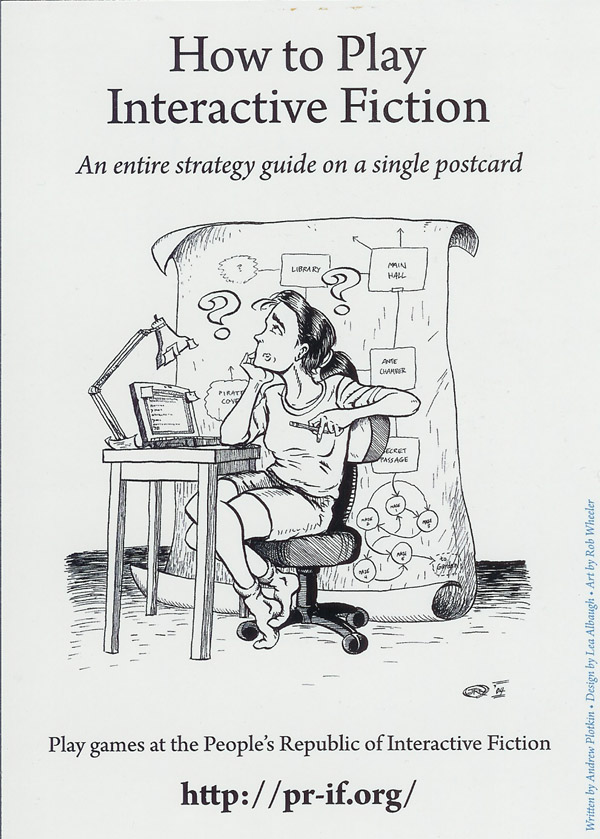
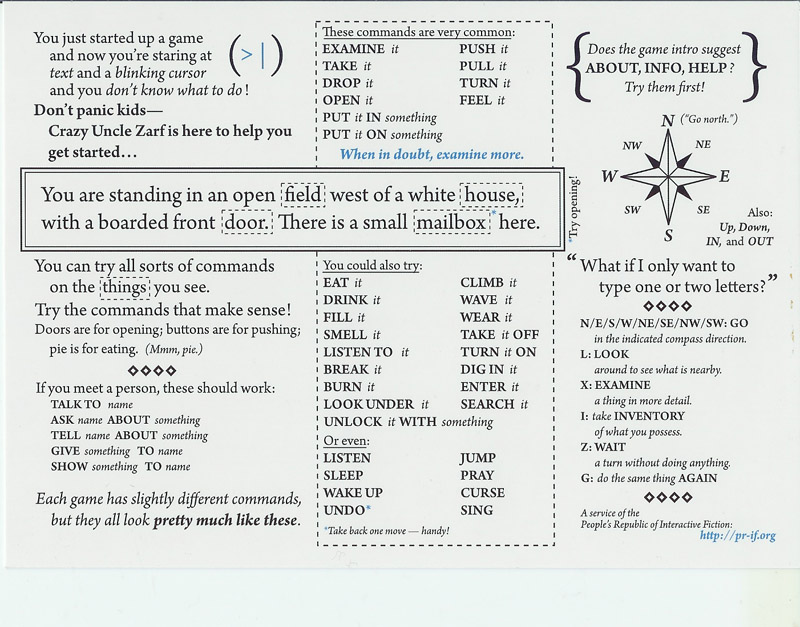
1) The swag! Robb Sherwin put together a great IF promotional CD (this, but updated with newer stuff) to give out to visitors. There was also a nifty postcard, with art on the front and a handy how-to on the back. Plus: badge ribbons, stickers, buttons, and nametags!

2) The food! Zarf & co. were kind enough to provide lots and lots of chips, M&Ms, and soda, and others brought delicious treats as well. Across the hall, Ben Collins-Sussman and Jack Welch even provided beer! Woo hoo!

3) The energy! At any given moment, there were usually two or three conversations going — newbies connecting with veterans, different subsections of the community interconnecting, people getting acquainted who had never really met before. People talked about IF, and also about their lives, what was happening at the conference, and what was for dinner that night.

4) The special guest stars! Don Woods, co-creator of the original Adventure, came to an IF panel and chatted with folks. I got to hang at the edge of a conversation between Emily Short and Steve Meretzky, so I got to thank the latter for his work, which has meant a lot to me over the years. Especially A Mind Forever Voyaging. Wow. Jason Scott hung out for a while doing his larger-than-life, bursting-with-anecdotes thing. It was a bit like a bunch of indie bands hanging out together, and then occasionally Paul McCartney or Robert Plant might drop by.

5) The people! I suppose this is a superset of the previous one, but holy cow, this room was PACKED the entire weekend! There was something really special about this locus of passion and force about IF. I loved talking to people who were new to the scene. I loved talking to people who had become community celebrities in the time I’ve been out of the loop. I loved talking to people I’ve known for years from the other side of a screen. I loved being in that room.

Prelude to PAX: Drive Like The Wind [Misc]

[I originally posted this on my other blog, >SUPERVERBOSE, way back when it was on livejournal. It’s the first in a series of posts about my visit to PAX East 2010, which not only revived my interest in IF after becoming a parent (Dante was 4 years old at the time), but also gave me the mental clarity to put boundaries around my out-of-control job. I’ve cleaned up the text ever-so-slightly.]

*************************
Thursday, January 25, 2010

You’ve been looking forward to it for months: a unique gathering of interactive fiction authors, organized around the huge gaming convention PAX East and the new IF documentary GET LAMP. As is your habit, you’ve arrived at the airport plenty early — you pull into the the shuttle parking lot at 9:15pm for an 11:25pm flight. You open the trunk to see your suitcase and… wait. What about your laptop case? What about your little travel bag? Good lord, what about your TICKET?

Oh no.

DRIVE LIKE THE WIND
A non-interactive recounting by Paul O’Brian

Shuttle Parking Lot
It’s dark, and the lot is full. The bus waits to take you to the airport. Of course, the airport is for people who have plane tickets, unlike yourself.

Your car is here, with the trunk open.

> LOOK IN TRUNK
No matter how many times you look, your other bags do not appear in the trunk.

> SWEAR
That doesn’t help. Well, maybe it helps a little.

> CLOSE TRUNK. GET IN CAR.
Closed.

You climb back into the driver’s seat and shut the door.

Your Car
The air in the car is still warm, and so is the engine.

> CALL LAURA
You start talking on the answering machine, and Laura picks up the phone. “Okay,” you say, “is my backpack sitting by the front door, or am I just having a bad dream?”

“Oh, and your little black bag too,” she says, her voice full of concern. Immediately, she’s trying to figure out how to help. Can she meet you somewhere halfway between the airport and the house? Sure, she’s been sick with a horrible intestinal bug and Dante just got tucked into bed, but she’s ready. What a partner. Still, you can’t quite bring yourself to drag them out of the house to make up for your stupid mistake. Not when you still have a chance. You tell her to sit tight, and that you’ll call her if you need her to go somewhere.

> DRIVE HOME
First things first. You have to find your way out of this shuttle parking lot, which you’ve never used before. You waste precious minutes looking for exit signs, and when you finally find one, it points you back down the trail you just came from. Finally, you’re out of the parking lot and back on the road.

> TIME
The time is 9:20pm. Your flight leaves at 11:25, and the gate closes at 11:10.

> DRIVE HOME
You’re back on Peña Boulevard, driving as fast as traffic allows, wondering if there’s some smarter way to get home.

> OPEN GLOVE COMPARTMENT
Opening the glove compartment reveals, among other things, a GPS.

> GET GPS. SET GPS FOR HOME
Taken.

With practiced thumbs, you tell the GPS to take you home by the fastest route. Yeah, you can still do this while going 70mph.

> PUT GPS IN BRACKET
Probably not the best idea, but you reach forward awkwardly, trying to snap the GPS into its mounting bracket on the windshield. The car swerves as you lean against the steering wheel, veering off the road at alarming speed!

> UNDO
Last turn undone.

> DRIVE HOME
Holding the GPS against the steering wheel, you follow its prompts back onto I-70, then I-270.

> TIME
The time is 9:50. Your flight leaves at 11:25, and the gate closes at 11:10.

> RECRIMINATE ME
Done, once again. Man, you spent the whole day making sure everything was ready, and then you drive off without half your stuff? What’s up with that? Laura said it was because you’re fried, and she’s not wrong about that. Aside from the fact that your day job has turned into a day, night, and weekend job, there’s the fact that you’ve been nursing both Laura and Dante through the same icky illness. You’re low on sleep and burned out. That’s part of why you were looking forward to this trip. Well, it’s certainly started out relaxing, hasn’t it?

> DRIVE HOME
You arrive in your driveway and Laura, bless her, is immediately hustling out the door with your bags in her arms. She throws them in the car, gives you a quick goodbye and you’re back on the road.

> TIME
The time is 10:00. Your flight leaves at 11:25, and the gate closes at 11:10.

> DRIVE TO AIRPORT
The trip goes without incident, but not one minute faster than you had hoped. You’re still pushing your luck. As you approach the airport, you can drive to the shuttle lot, the economy lot, or the garage. The closer you get, the more you pay, but then again, doesn’t every minute count?

> DRIVE TO GARAGE
Garage it is. $18 a day, but that’s a lot less than trying to rebook a flight, isn’t it? You find a space close to the terminal and park.

> TIME
The time is 10:45. Your flight leaves at 11:25, and the gate closes at 11:10.

> ENTER AIRPORT
You quickly haul your bags out of the car and sprint into Denver International Airport.

DIA, Terminal East
It’s late, and all the stores are closed, not that you have time for shopping. You offer a silent thanks to JetBlue, who allowed you to check in online. Your gate is in Concourse A, and you can head straight to security. The north security checkpoint is to the north, and the south security checkpoint is, well, to the south.

> N
Your feet pound against the smooth floor and your heart pounds in your chest.

North Security Checkpoint
A long, winding snake made of freestanding posts connected by extensible rope-line barriers. You can enter security from here, or go north to the Concourse A bridge.

> N
Concourse A Bridge
The bridge to Concourse A is uphill — of course it is — but it also seems to be under some construction. The security checkpoint is ahead.

> RUN TO SECURITY
One of the workers stops you. “That security checkpoint is closed,” she says. So how do you get to security? There’s only one checkpoint open this time of night. Which one is it? It’s the south one. Of course it is.

> SWEAR
Still not helping. Much.

> TIME
The time is 10:48. Your flight leaves at 11:25, and the gate closes at 11:10.

> S. S. S.
North Security Checkpoint

DIA, Terminal East

South Security Checkpoint
Oh, no wonder the other checkpoints looked so deserted. Everybody’s at this one. Who knew so many people took redeye flights on a Thursday night? The line winds around a few times, and seems to be designed for your personal maximum inconvenience.

By the way, your burning legs have informed you in no uncertain terms that you will not be doing any more running in the near future, so don’t ask.

> TIME
The time is 10:53. Your flight leaves at 11:25, and the gate closes at 11:10.

> ENTER SECURITY
The line entrance is at the other side of the — no wait, it’s on this — where the hell is the line entrance?

> DUCK UNDER BARRIER
Trying not to knock anyone or anything over, you attempt to smoothly slide under the fabric of the barrier. Of course, you’re not used to wearing a backpack, so you do knock over the the posts on either side, and manage to make the extensible line reel back into one of the posts. A kind woman helps you reassemble it. You feel like such an ass. You can’t help thinking of Homer Simpson charging through a crowd, shoving people aside, saying, “Out of my way! I got here late!”

> CALM ME
You take a few deep breaths and try to pull it together. The line in front of you seems impossibly long.

> XYZZY
Nice try.

> Z. Z. Z.

Time passes.

Time passes.

Time passes, and you finally make it to the front of the line. The security people are very friendly and reassuring. “You’ll make it,” they keep telling you. More deep breaths. Shoes off, coat off, laptop out, etc. etc. You get through the line, and then reassemble. Laptop away, coat on, shoes on, etc. etc. Past the checkpoint, down the escalator, to…

Train Platform
This is where you can board trains to any of the concourses. The train is not here.

> TIME
The time is 11:00. Your flight leaves at 11:25, and the gate closes at 11:10. The minutes seem to be stretching out now that you’re getting close to your goal. About time those minutes did you a favor.

> Z
Finally, the train arrives.

> ENTER TRAIN
You board the train, which whisks you to Concourse A past 5,280 spinning propellers mounted on the passage walls.

From here, it’s smooth sailing. The train deposits you at the concourse, and a brisk walk takes you to the gate. The doors are open, and you get straight onto the plane, with 5 minutes to spare and adrenaline jetting through your body. Oh yeah, you’ll be sleeping soon.

*** You have won ***

Your score is 100 out of 100, giving you the rank of Tired Traveler.

*************************
More soon about the actual trip. I just had to recount my most ridiculous act of self-sabotage so far this year.

Attack of the Yeti Robot Zombies by Øyvind Thorsby [IF-Review]

[I originally reviewed this game for Mark Musante’s site IF-Review, in 2007.]

IFDB Page: Attack of the Yeti Robot Zombies

Attack Of The Yeti Robot Zombies announces two facts right upfront. First, it is a “try-to-win-on-the-first-attempt game”, which means that while SAVE, RESTORE, and UNDO have not been disabled, players are honor-bound not to use them. Secondly, the game tells us that “Examine, look at, look inside, look under, look behind, look and search have not been implemented.” I was surprised to discover that the latter aspect threw me off much more than the former one did. It turns out that examining things is so ingrained into my IF approach that having that feature disabled made me feel like an amputee. Frequently, I would try to examine an item before being reminded: no, that limb is missing. Taken together, what these features present us with a game in which the crossword has decisively defeated the narrative, to use Graham Nelson’s terms.

AOTYRZ presents a world, but it’s only scraps of clothing over otherwise bare puzzles. The title monsters are a perfect example of this. What on earth could a “Yeti Robot Zombie” be? A cybernetic duplicate of an Abominable Snowman who was killed and then revived to be even more mindless than it was before? Is there any universe in which that makes sense? Aren’t “robot” and “zombie” mutually exclusive categories, since something that was never alive can’t be killed and brought back to life? The game doesn’t know, and it doesn’t care. It might as well be called “Attack Of The Generic Monster Placeholders,” because that’s all that the YRZs are. If you don’t believe me, just try examining one.

So, given that this is a puzzle game whose story is sputtering and gasping for breath, how are the puzzles? Mixed, I’m afraid. I took the “win-on-the-first-attempt” rule rather seriously, and ended up feeling quite disappointed at the number of times I had to learn the game’s mechanics by dying. Now, in its defense, AOTYRZ does go some reasonable distance towards making the game winnable on the first try. Similar to Wishbringer (though quite a bit cruder), it gives the player a resource which can be used as an alternative solution for all the puzzles. This resource can only be used a limited number of times — fewer than the number of puzzles — which means that some of the puzzles must be solved in order to win on the first attempt. That’s not too bad though, because some of the puzzles are pretty easy.

However, unlike Wishbringer, it is impossible to win the game (near as I can tell, anyway) without using that resource a couple of times. There’s no way to know this fact in advance without some outside information, which throws a serious obstacle into the path of anybody trying to win on the first attempt. The game chided me every time I used the resource rather than finding the cleverer solution, and after a couple of rounds of this, I felt the message was clear: there will always be a better solution available, so I should always figure it out and use it. Then, a few puzzles later, the game hit me with a situation for which there was no better solution. Even worse, this situation was so thinly implemented that it almost seemed to be a bug rather than a change-up. It was there that my first attempt at AOTYRZ ended in ignominious death.

From that point forward, since I had to restore, I tried some alternative solutions, and found that while some were rather nifty and scrupulously fair, others were impossible to use without either knowledge from a prior life or some pretty lucky guesses. Also, a note to game designers: if something is chasing me, and you block my path with something I can move, please allow me to use that something to block the door behind me. Thank you.

Once it wasn’t my first attempt anymore, I started having a lot more fun with AOTYRZ. Yeah, it’s a bare puzzle game, but some of the puzzles are pretty snappy, and the plot (such as it is) moves along at an enjoyable clip. In addition, while the game world’s implementation is necessarily sparse due to the absence of EXAMINE, what’s there is competently constructed — I didn’t find a single bug. The writing isn’t quite as flawless. There are a number of typos, some of which serve up some unintentional (but very funny) comedy. My favorite comes in a cutscene where the PC is receiving remote instructions from a guide:

“The teleporter worked.” you say in the phone.
“It did? Really? That’s great! Now walk up the stairs and you will find two doors. It doesn’t matter which one you take, both will lead to a roof.”
“Then what?”
“On each roof there will be a helicopter. I assume you know how to fly one?”
“Off course.”

Oh, well is there anybody there who can fly a helicopter without going off course? Anyway, those moments aside, the writing serves its purpose well enough. I can’t muster a huge amount of enthusiasm for AOTYRZ — it takes a pretty audacious approach and then fails to provide a sufficient follow-through. However, if you don’t mind an IF world with no depth and you don’t worry too much about really winning on the first attempt, the game can provide a pleasant diversion for an hour or two.

Eragon by Unknown [IF-Review]

[I originally reviewed this game for Mark Musante’s site IF-Review, in 2006.]

IFDB Page: Eragon

Eragon Vs. Bygone Era

IF aficionados have often made the argument that the medium could have a commercial comeback if marketed in the right way. Forget gamers, the line of reasoning goes. Instead, interactive fiction should be sold in bookstores, right alongside the books, appealing to an educated, literary audience that sees “all words no pictures” as an advantage rather than a drawback. After all, The Hitchhiker’s Guide to the Galaxy was one of Infocom’s biggest hits, and it seems reasonable to conclude that that game drew much of its audience from people who loved the books. (Leave aside for a moment the tremendous overlap between fans of those books and computer nerds.) Perhaps the beginning of this IF resurgence might be text games appearing on author websites, inviting fans of that author to experience their favorite fictional world interactively, possibly re-enacting some key scenes, or filling in some narrative gaps from the paper stories.

I’m not sure I believe that IF will ever experience a commercial comeback on any significant scale, but I love the idea of skilled authors with large fanbases creating text adventures. Consequently, I was excited to learn that Christopher Paolini, author of the “Inheritance Trilogy” of young adult fantasy novels, had placed a text adventure on his site, set in those books’ universe. I’ve never read Paolini’s work, but his books seem to be popular with the kids, what with the first one spending months on the New York Times’ bestseller list and having over a million copies in print. The fact that such a popular author was offering interactive fiction based on his books seemed quite promising to me, and I was eager to check it out. A web browser is a lousy place to play a text adventure of any size, given that Zplet doesn’t provide for SAVE and RESTORE, so once I found the game I dug the zcode file out of my browser cache and played it locally. It would be nice if the author’s web site had provided an easier option for downloading the game file, but that’s a forgivable lapse. I fired up the game, all energized about the bright possibilities.

Unfortunately, that energy evaporated almost immediately. The first thing I did was turn transcripting on, and saw this:

Start of a transcript of
Eragon
Eragon.
Release 1 / Serial number 050712 / Inform v6.30 Library 6/11 SD
Standard interpreter 1.1 (4F) / Library serial number 040227

Uh-oh. Debugging verbs left on: not a good sign. Also, what’s with the subtitle being just the title with a period added in? Finally, where’s the author credit? Did Paolini actually write this game, or did he leave his name off because some employee or fan of his is the real author?

Having played the game, I’d put my money on the latter. Both in terms of design and prose style, Eragon feels like the product of a member of its intended audience: readers in their early teens. At the very least, given the number of comma splices and grammatical missteps in the game, I think it’s safe to say that this prose has never seen the services of a professional editor. The milieu of the game itself feels like Tolkien with just a few of the serial numbers rubbed off — apparently you’re a dwarf in the tunnels under “Farthen Dûr”. Your quest is to warn the “Varden” (i.e. the good guys) that an “army of Urgals” (i.e. orcs) is approaching. In the process, you’ll come across some magic dust that makes people fall asleep, mysterious runes concealing hidden rooms, huge underground chambers, and so forth. It’s bog-standard stuff.

As for the game itself, well, I wish the news was better. It’s not that this game is out-and-out terrible. Worse games get submitted to every single IF competition. However, it suffers from some very serious flaws. The worst of these is the way it deploys a kind of “selective parsing” that makes it feel like a product of 1983, despite having been produced with Inform 6. Several times throughout Eragon, I found that the parser would claim not to understand a particular formulation, only to specifically require that formulation at a later point. This kind of thing is simply unacceptable in a text adventure — if you tell me a command is not understood, don’t expect me to try it again. A variation on this is the way that at certain junctures I found myself wrestling with the parser, trying to communicate a specific idea, only to learn that the game would only accept the most generic command possible, doing all the rest of the heavy lifting itself. Here’s an example, altered to remove spoilers:

>X TRAP DOOR
The stone trap door is covered with finely carved runes and etchings
of intertwined dragons. There is an empty space in the center, just
about the size of the marble orb.

>PUT ORB ON DOOR
Putting things on the Trap Door would achieve nothing.

>PUT ORB IN CENTER
I do not understand your command. Doublecheck your spelling or refer
to the commands list for help.

>OPEN TRAP DOOR
The door is locked, and simply impassable.

>PUT ORB IN STONE
You can't put something inside itself.

>X CENTER
I do not understand your command. Doublecheck your spelling or refer
to the commands list for help.

>USE ORB
The orb slips perfectly back into place, becoming one with the door.
The door, now unlocked, automatically begins to slide open, dragging
heavily along the floor.

The puzzles themselves are pitched at a good level for kids, but any kid would be driven crazy by how frequently this game fails to parse.

Alongside the technical failures is some highly irritating design, the centerpiece of which is a large maze. This maze isn’t terribly challenging — the game is kind enough to give each location a distinctive name, like “Maze M18”, “Hallway H6”, and so forth — but it is so, so dull. Wandering through one empty location after another, following the left hand wall, is not my idea of a good time. Hilariously, the game helps orient you by telling you that you hear singing, loudly or faintly, from a particular direction, but when you get to the source of the sound it seems to forget that it ever mentioned singing. There’s a person there, but I never saw her sing. In addition, there are several spots where I flummoxed the game by doing things in a different order than it expected. For instance, there’s a library section where I thumbed through the books and was told, “Upon realizing that this is not the book you are looking for, you return the book to its place on the shelf.” Unfortunately, I hadn’t yet met the character who told me what book to look for, which made that message rather nonsensical. I’d venture to guess that the game was written to a walkthrough and not playtested thoroughly enough to uncover its hidden assumptions. Tons of formatting errors, capricious capitalization, and logical lapses add to the unpolished feeling.

I realize that all this criticism is negative, and I don’t mean to be too discouraging, especially if Eragon was written by some young Paolini fan as a labor of love. I think the lesson that emerges from this game is that although it would be great for popular writers to offer interactive fiction based on their works, they should probably do so in collaboration with experienced IF authors if they’re unfamiliar with modern IF themselves. After all, even Douglas Adams didn’t try to write the Hitchhiker’s game himself — the participation of Steve Meretzky helped ensure that the game would not be a hash of bugs and mainframe-era game design cliches. Similarly, modern authors would do well to avail themselves of the knowledge contained within the modern text adventure community. Combining a popular writer’s skill and imagination with the technical expertise and experience of an established IF creator would be most likely to result in a game that puts both the author’s works and interactive fiction itself in the best light. Without that creator’s insight, you run the risk of games like Eragon, which makes IF fans want to avoid more Paolini and Paolini fans want to avoid more IF.

Bronze by Emily Short [IF-Review]

[I originally reviewed this game for Mark Musante’s site IF-Review, in 2006.]

IFDB Page: Bronze

Alloys and Allies

The unveiling of Inform 7 is hugely exciting for many reasons, not the least of which is a sudden bounty of new games by Graham Nelson and Emily Short. These example games are meant to show off various capabilities of the development system, but the designers being who they are, the games are likely to be eminently playworthy in their own right. This review begins what I hope will be a series [Welp, that didn’t happen. — 2021 PO] that illuminates the value of these example games to players, quite aside from what they demonstrate to authors.

First on the list is Bronze, an adaptation of Beauty and the Beast and an old-fashioned puzzlefest, though only old-fashioned in the good ways. There are no mazes, no hunger puzzles, no expiring light sources; for such favors I thank the author sincerely. What we have instead is a large landscape (in this case the Beast’s castle), a well-paced plot punctuated by clever puzzles, and a variety of endings that allow for varying interpretations of the main character. The PC herself goes unnamed, but she is clearly the Beauty of the story, known as Belle in many versions, including both the Disney and Cocteau films. The tone of this game is much closer to the latter, pleasantly. In fact, Bronze reminded me often of Cocteau’s La Belle et la Bête — its gloomy, echoing chambers, its magical aura, and of course the wounded, romantic figure at its center.

Bronze‘s castle is less wildly inventive and evocative than Cocteau’s, though of course this is a rather rarefied standard to apply. What it does have over any other adaptation I’ve seen, however, is dimensionality. This game cannily exploits the strengths of IF to use its landscape for multiple ends. At the most basic level, it arranges the map in three dimensions, and at several points forces us to think not only of what is around us but what is above and below. A further (and more interesting) depth accretes as the PC’s memories surface in connection with certain rooms and objects. This is not a new trick in IF, but it’s very well-wrought here. Later in the game, we are shown yet another dimension via a magical item that allows us to hear the memories that other characters attach to various places. In addition, the game lays in a great deal of history to the castle, the Beast, the Beast’s family, and so forth — indeed, learning this history is essential for completing the game. The historical information is nicely woven, mostly avoiding infodumps and cutscenes in favor of memory-freighted objects and consultable items.

On the down side, though, the need to CONSULT X ABOUT Y so often was perhaps Bronze‘s greatest weakness for me. I got rather impatient with having to plumb so many sources about so many topics, especially when only one of the sources was portable. No doubt I’m rather spoiled by small competition games. Perhaps more to the point, I squeeze IF into the corners of my life and thus am not only unable to remember many details from one play session to the next but also reluctant to take notes while playing. I’d imagine that someone in a different mindset would find all the research opportunities quite rewarding. I did not.

Another choice that stymied me was the structure of the endings. My first attempt at Bronze terminated rather abruptly, at a less-than-optimal ending, and it was not immediately apparent why I couldn’t keep proceeding to complete the other goals that would have led to a more satisfying conclusion. The answer had to do with my failure to consult a particular item about a particular topic before that item disappeared, but I did not put this together until after I had turned to the walkthrough. Even after I understood the problem, it still felt a little unfair to me — I wish there were a bit more space in the design to prevent such accidental losses. Finally, there were one or two aspects of the magic system that took me a long time to figure out. Some of this may have been due to haste on my part, but I think they were also a little underdescribed.

Enough whinging. An area where Bronze really shines (uh, no pun intended) is in its technical prowess. Its blurb text promises “a number of features to make navigating a large space more pleasant,” and those features are lovely. GO TO <location> navigates the best path from the player’s present location to the target room, a godsend for the many, many occasions when one has to trudge from one end of the castle to the other. Similarly, FIND <object> takes the PC directly to the target object’s location via the same pathfinding method. Bronze also implements LOOK <direction> to let the PC investigate adjacent rooms without traveling to them. Other great features include an adaptive hint system accessed via the THINK ABOUT verb, and a status bar that shows not only what exits are available but also color-codes those directions according to whether they have been explored or not. Finally, I must mention the very newbie-friendly, context-sensitive “novice mode” that gently injects instructions for how to deal with the IF interface throughout the game. In fact, Bronze is a game I’d recommend for newcomers to the form, since its story is a familiar one, its help system is extensive, and its writing is rich and enjoyable.

A few more words about that writing. Short’s style is a familiar one by now: elliptical but densely packed, full of arresting images and subtle wit. At times, devoting so few words of description to so large a map can make the game feel a bit sparse, but more often it achieves a lovely mystique, showing us just enough to intrigue and enchant. Many sentences are striking in both their economy and power, such as this description of a door:

The work of the hinges and handle, the color of the wood, the point of the arch: all malevolent.

In addition, the imagery of the castle’s fixtures is pure Short, such as the giant hourglass whose sands never stop pouring, or the cherry-wood floor in which is carved an expansive map of the Beast’s kingdom. Another authorial trademark that will be familiar to fans of Savoir-Faire is the game’s detailed working-out of a magic system and its implications not only for puzzles but for character and story as well. Bronze is no masterpiece, but it is a well-crafted, fun, and satisfying game. I recommend it not only to people wishing to learn Inform 7 but to all fans of quality puzzle-laden text adventures.

1893: A World’s Fair Mystery by Peter Nepstad [IF-Review]

[I originally reviewed this game for Mark Musante’s site IF-Review, in 2009.]

IFDB Page: 1893: A World’s Fair Mystery

World Class

Peter Nepstad has performed a minor miracle. He has made money, significant money, as an IF author. According to a recent SPAG interview, he’s sold about 3700 copies, at a retail price of $15-$20, mostly $20. The majority of these sales came from brick-and-mortar stores where his game is for sale. Let me say that again. Peter Nepstad wrote a game himself, made deals to get it sold in stores as well as online, and has sold several thousand copies, netting thousands of dollars.

And all he had to do was work ridiculously hard, over a period of many years. The subject of Nepstad’s game is the 1893 World’s Fair that was held in Chicago, Illinois. Nepstad researched the fair thoroughly, collecting hundreds of photographs (over 500 of which are scanned into the game), and recreating historical artifacts from the era. Once the game was completed, he arranged for publication on CDs and got his product onto the shelves at gift stores in various Windy City attractions, such as the Chicago Architecture Foundation, the Museum of Science and Industry, and of course the gift shop at the World’s Fair site. He sought out press attention, garnering favorable reviews from (among other places) the Associated Press, the Chicago Sun-Times, and Games magazine.

Then there’s the game itself. People, this game is enormous, and has to be the product of an absolutely Herculean effort. Every time I thought I had a handle on how big it is, I’d discover some new aspect and have to revise my estimate upward. Here’s an example: there are some places in the game in which it is necessary to bring a light source. Guess how many rooms I searched before finding a light source? 273. Two hundred and seventy-three rooms. These weren’t crummy carbon-copy rooms either, not randomly generated locations from some teeth-grinding maze, but full-fledged parts of the game’s faithful historical simulacrum. Why do I know the exact number? Because after my first several hours exploring the game, I had to start keeping a spreadsheet just to track which places I’d visited, which puzzles they contained, which exits I’d tried, and so forth. Not only that, but the 4th dimension is implemented and important — some areas are only open at certain times of day, certain events only happen on a particular day, and missing an appointment can mean losing the game.

The experience of exploring this game is satisfying in itself. Between the epic scope, the detailed room descriptions, and the well-chosen photographs, I often got a frisson of time-travel sensation, a level of immersion that made me feel transported back across the centuries. The theme of the fair was a celebration of Columbus’s arrival in the Americas (the 21st-century political thorniness of which the author addresses in an afterword), and exploration is the order of the day both in the fair and in the game. In fact, once we reach the climactic endgame, the PC is literally tied to a chair to have the plot shouted at him, and while this would drive me crazy in most games, I didn’t mind at all in 1893 — it was almost a relief from having to maintain a gargantuan mental map and keep track of a variety of temporally spaced events. Dealing with the game’s size (330 rooms!) actually constitutes one of the most challenging aspects of 1893. There is a definite sense of overwhelm that lasts for a long time, until you finally get the game’s geography straight in your head.

There’s a pleasant sense of artistic unity to the interface, which consists of a text window, a graphics window, and a compass rose, garnished with just a bit of fancy Victorian filigree. Occasionally, the pictures and compass disappear for effect, but for the most part, we can always see exits at a glance, beneath a visual representation of the location. These photographs are a great touch, and some of the images Nepstad has chosen are absolutely wonderful, compelling images that would be interesting in any context, but are all the more arresting for accompanying such a thorough simulation of their original setting. The combination can create a potent sense of place.

The game presents a serviceable plot to motivate exploration: you play a detective called to investigate the disappearance of eight large and precious diamonds from one of the fair’s exhibits. The thief has hidden the diamonds all around the fair, ensconced within various puzzly contraptions, and scattered clues to their locations a la The Riddler. It must be said that this plot does not make a great deal of sense, and contains some serious holes — at least one of the diamonds is hidden in a way that seems logically impossible to me. Still, it marries traditional text adventure concerns to this large simulation, transforming 1893 from a model into a game. The simulation is huge enough to entertain a history buff without ever having to get involved in the puzzles, while the game aspects are engaging enough to gratify text adventure enthusiasts.

Nepstad has a keen sense of spectacle, and effectively conveys how breathtaking some of the fair’s wonders must have been to its visitors. In addition, he throws some fun twists and turns into the plot, generating moments of real excitement to punctuate the player’s long journey through his game. He demonstrates a real flair for action sequences — there are a couple of terrific set-pieces worthy of any period thriller. The whole thing winds up in an ending that I found absolutely spectacular, an enthralling finale that provides a fitting close to the game’s very slowly rising action. I finished 1893 feeling, overall, happy and satisfied.

Given all that, it feels a bit churlish to complain about the game, but it must be said that there were some aspects of 1893 that I found disappointing. Foremost among these is, believe it or not, its widespread underimplementation. I know I’ve just extolled the game’s largesse and emphasized how much work it must have taken, but while its scope is immensely broad, its implementation is often frustratingly shallow. Often the wonders of the fair seemed more like a background painting, because so many of them lacked descriptions. Worse, some of the basic functionality around them was all too thinly provided. For instance, when the PC finds a full pack of Cairo cigarettes:

>look in pack
There's nothing in the pack of cigarettes.

>get all from pack
I don't see what you're referring to.

>get cigarette
You pull a cigarette out and close the pack.

>smoke it
You'll have to open the pack of cigarettes first.

>open pack
Opened.

>smoke it
I don't know how to smoke the pack of cigarettes.

>smoke cigarette
I don't know how to smoke the cigarette.

>smoke cairo
You'll have to light it first.

This, this is the kind of thing that earns IF its reputation as perverse and obfuscatory. Who but the masochists among us (and I include myself) wouldn’t type QUIT after a sequence like this? It makes me wince to think about newcomers to IF (some of whom this game surely found) encountering such obtuse implementation. There were some serious parsing problems throughout the game — for instance, SEARCH means something different from LOOK IN, so you could search something and still not find a crucial item that “look in” would have found. Synonyms were lacking in numerous instances, and some very basic verbs were missing, such as WAVE, CUT, ARREST, and WASH. When I’d attempt one of these commands, the game would respond, “There’s no verb in that sentence!”, which is of course patently false. Poor parsing and thin implementation are a deadly combination, especially as the suspense ratchets up. As I said, Nepstad has a flair for action sequences, but the game’s failure to understand or meaningfully respond to reasonable commands could be a serious tension-deflater in crucial moments.

NPCs in 1893 suffered from the same sparseness, most lacking responses to all but a very few topics and actions. The details that are included with them are often well-chosen, so some (such as a small boy and a Japanese woman) manage to be evocative despite their flimsiness, but very rarely do any of them ever feel like real characters rather than code constructs. The biggest sin here is when characters fail to respond to actions that absolutely should compel them — for instance, as a suspect very very slowly escapes, the PC can go straight to the headquarters of the fair’s security staff, but inexplicably can’t get their attention: “They are all hustling about so quickly you find it impossible to interrupt any of them,” says the game. Really? I’d rather have seen the office empty than have the game so willfully deflect a logical action. It isn’t a virtue to turn underimplementation into a puzzle, and that’s what happens at several junctures in 1893. Sensible alternate solutions aren’t accounted for, and actions that deserve a response go begging.

In addition, there are some persistent problems with the game’s writing, led by my personal nemesis, the its/it’s error. I must have found at least 20 instances of this, a circumstance tailor-made to drive me crazy. In addition to mechanics, there are just some really weird, illogical pieces of description, such as the Mysterious Case Of The Androgynous Seamster(ess?):

A small loom of antique design, made entirely of wood, is being used by an old woman, moving the treadle by foot, and the shuttles by hand, while all around him, the new mechanical looms weave several pieces at once and in a fraction of the time.

>ask man about loom
I don't see any man here.

>ask woman about loom
The old woman doesn't seem to hear you.

>x antique
The loom looks almost as old as the man who is working at it.

(My emphasis.) Finally, there are a number of flat-out bugs in the game — freaky TADS errors, strange scoping problems, or moments when it simply does not respond at all to player input. And of course, there’s always the classic “Which buildings do you mean, the grand buildings, or the grand buildings?”

For the most part, this stuff boils down to “needs further testing,” but then again I can certainly see how there’s plenty of room for mistakes to remain in a game this huge. Moreover, I’m sympathetic to the fact that with all the nouns included in this game, the prospect of describing a significant number of them might feel too overwhelming to face. I’d posit that perhaps projects of this size, especially if they are intended to be commercial ventures, could use one more person “on staff.” That person could not only serve as first tester and copyeditor, but he or she could also perform the tedious but crucial duty of filling in descriptions for first-level nouns and coding for alternate solutions, providing richness that might be too much to ask of one implementor but which can make the difference between immersion and infuriation for the player.

I should mention that a number of details are well-attended — for instance, the “can’t go” messages in each room usually help the player out by naming the exits. The puzzles, for the most part, are also logical and well-cued. A few times, I found myself wishing that the game had given me a clearer indication towards some important aspect necessary for solving a puzzle — in particular, there’s a crucial demonstration that only happens once a day but is not announced anywhere I could find. Still, this was the exception. Most of the game’s puzzles (and there are many) are solvable and fun, and while there were a few instances where I turned to the hints, they turned out to be mostly due to my own boneheadedness. There were a few times when a puzzle stretched plausibility, such as the time I was handed a baby and treated it as just another inventory item.

Then again, I’m willing to believe that the business with the baby could have been a subtle joke on the game’s part. One of the more enjoyable aspects of 1893 is its light tone and affable wit. A few parts of the game are outright comedy, and hilarious comedy at that. An outstandingly pompous tour guide can lead you through the fair, speaking in the prose of the most overwrought Victorian novel, to humorous effect. There’s a wonderfully funny scene with a mouse, and some excellent parser responses, including one I can’t help quoting, from a room with a huge pillar of anthracite coal:

>kiss pillar
Too bad you missed Dr. Freud's visit to the fair, he would have loved to meet you.

Okay, it’s a comma splice, but still damn funny. Other nice touches include the occasional cameo by historical figures, such as when you spy Frank Lloyd Wright and Louis Sullivan discussing the design of the Japanese temple.

Alongside this clearly intentional comedy were some instances of a murkier sort. Sometimes I wasn’t sure whether the game intended a wink to accompany its message, such as this statement from the tour guide: “The French have often been called the most polite nation in the world, but France must surrender the palm to America.” I dunno, maybe cultural perceptions have shifted radically, but from my 2008 perspective, I thought, “Oh yeah, America is the capital of politeness. Trailed only by France.” Or take another instance, a pomological exhibit featuring a Liberty Bell replica made of oranges:

>x liberty
You pause for a moment, wondering what kind of person would spend his time making a replica of the Liberty Bell made entirely out of oranges.

Or, for that matter, what kind of person would spend his time making a replica of the 1893 World’s Fair made entirely out of TADS code? Is it dry self-deprecation or straight-ahead ingenuousness? Oh, and then there’s the mysterious matter of the “homacoustic commutator”, an object defined (as far as I’m concerned) with two nonsense words, and described thus: “The homacoustic commutator is equipped with an electric signalling device.” Say what? I had to conclude that the game was joking with me here. Either that or it decided to edge for a moment into a steampunk version of The Hitchhiker’s Guide To The Galaxy.

Actually, that’s not as outlandish a prospect as it might sound. There were a couple of cases where the game suddenly, jarringly threw in a dose of science fiction or magic, for no easily discernible reason. These moments are certainly exciting (and shocking) when they happen, but I think they weaken the game overall. In such a realistic simulation, these easter eggs deal a killing blow to mimesis, throwing me right out of any period immersion I might be feeling.

Speaking of easter eggs, I am ready to declare that 1893 has, hands down, the best easter egg I have ever found in any IF game. I don’t want to spoil it here, except to recommend that those who finish the game definitely try all the amusing actions laid out in the game’s afterword. There’s an easter egg tucked into this game that could practically serve as an entire comp game all by itself. That mini-game is plagued by much of the same underimplementation that appears throughout the rest of the game, but it also has the same great witty responses, the same sense of excitement, and the same clever puzzles as the rest of the game too. There are even easter eggs within the easter egg, if you can believe that. It’s terrifically impressive, in an “even his muscles have muscles” kind of way.

Other hidden actions might award the player a “bonus point”, and it’s a great feeling to get one of these, because it’s usually for some very satisfying action. 1893 isn’t shy about using the scoring system, and I think it exploits the system quite effectively, with the main score serving as a progress indicator and the bonus points as pure lagniappe. Speaking of bonuses, there are various fascinating historical texts embedded in this game, such as Lincoln’s first inaugural address, as well as some texts by Frederick Douglass and Ida B. Wells making the case for African-American representation at the Fair (though of course they don’t use that term.) I quite liked the way Nepstad handles race in 1893, presenting the accurate historical simulation but making sure to include the voices that at that time were protesting the exclusion of African-American culture.

There were a few parts where that accurate simulation broke down, anachronistic references to jacuzzis and homeless people, as well as this:

>buy banana
Any more bananas and you'd start to feel like Carmen Miranda.

Not exactly the thought an 1893 detective would be having, given the fact that Miranda was born in 1909. Still, these slip-ups were minor and rare against the huge tide of very well-researched content with which 1893 is overflowing. It’s a game that richly rewards exploration, that provides hours and hours of engrossing entertainment, that charms with its cleverness and awes with its magnitude. It has its flaws, but it’s well worth your twenty dollars.