Ninja II by Paul Panks as Dunric [Comp05]

IFDB page: Ninja II
Final placement: 36th place (of 36) in the 2005 Interactive Fiction Competition

So, like the other Panks game I played from this comp, Ninja II required me to fire up a DOSBox instance to get it working. However, unlike that other game, I found myself with very little patience for this one.

I’ve already written my rap on Panks, and what’s more, this game is almost identical to his entry from Comp04 — it has one additional “puzzle”, and those scare quotes belong there. (The puzzle, which is simultaneously ridiculously hard and stupidly easy, prompts you with “Dare you beat dragon?” and leaves you to determine exactly how that phrase works as a “clue”.)

Granted, I played the earlier version of Ninja 19 years ago, and remember virtually nothing from it (except that it’s bad), but I don’t need to revisit it. I’ve done my time. Plus, re-submitting a nearly identical game to your last year’s entry is obnoxious behavior, however you slice it.

Rating: 1.9

Beyond by Roberto Grassi, Paolo Lucchesi, and Alessandro Peretti [Comp05]

IFDB page: Beyond
Final placement: Tied for 2nd place (of 36) in the 2005 Interactive Fiction Competition

Here we are again: I couldn’t finish this game in two hours. I found it quite absorbing, and with 20 minutes left, I really debated whether to turn to the walkthrough or just play out my 20 minutes with a bit less dawdling around examining things, getting as far as I could. I picked the latter, but with 5 minutes left, I really wanted to know how the story turned out. So I peeked at the walkthrough, hoping to speed through to the end. NOPE! Turns out I was midway through chapter 4 of 7 (plus an epilogue) — just about halfway through, I reckon.

Back in the day I used to penalize games like this in my ratings, hoping to discourage people from this behavior. But it’s not like whatever I put here will deter people in, like, Comp06. Plus, as Michael Coyne taught me, authors have a strong motivation to enter their too-long games in the comp, and nothing I did as a reviewer could have changed that motivation anyway. And I’m obviously not trying to go through all these Comp05 games in six weeks — I started on these almost three years ago! So while I am still stopping after two hours to write a review, I’m not going to specifically take points off anymore, except to the extent that having to stop prematurely affected my enjoyment of the game. Heck, in some games stopping after two hours feels like a gift.

Stopping Beyond was disappointing, though, because I was deeply involved with its story, being pulled along at multiple levels. At the higher level, there’s a frame story, in which the PC is the spirit of an unborn child, exploring the reason why it wasn’t born. I was very wary when I encountered this premise, fearing that it would veer into an anti-choice polemic, but I needn’t have worried. Instead this concept brings us into a compelling murder mystery, in which we play a detective looking into the murder of a pregnant woman.

Really, I shouldn’t call the unborn spirit piece a frame story, because it returns after every chapter, in interludes where we see the murder scene as a ghost, or experience a bit of what life might have been like had the mother lived, or watch different scenarios of how that night might have gone, from a godlike remove. In the prologue, the game makes clear that the PC (and thereby the player) cannot affect her fate. She will never be born, and can only learn the circumstances surrounding that fact.

Thus the game takes place under a heavy layer of inevitability, similar to Photopia — a game to which Beyond pays a neat, subtle tribute by replicating one room and item description. And yet, also like Photopia, Beyond weaves a deeply compelling story around this unavoidable death. As the detective, we’re able to investigate the scene of the crime, talk to a wide variety of connected characters, and make clever observations that lead us closer and closer to solving the crime.

As any good mystery should, the plot takes several unexpected turns, and who knows how many more were in store, given that I was only halfway through the story when I reached my time limit? Not only is the plot well-crafted, but the presentation of the game is excellent as well. The whole thing renders in tan text on a black background, setting a nicely somber mood, and fantastic illustrations appear throughout the traversal, in that same color scheme. These illustrations might appear at the top of the text window, or on either side, and the game handles their appearance, persistence, and disappearance very smoothly, in a way that always enhances the story and never disrupts it.

The one Achilles heel in Beyond, I’m sorry to say, is that the game sometimes demonstrates a rather shaky command of English. Every so often there’s a mention of a baby “wrapped in white clothings”, or a character who says, “I have took the water”, or a phrase like, “I feel like I’m bringed away.” All things considered the errors aren’t overwhelming — certainly not the trainwreck that some broken English comp games turn out to be — but enough to throw me out of the story when they happen.

Nevertheless, this bothered me much less than it might have, and that’s down to the overall outstanding craft that was put into the game. It was one of those that I wish I could give more time, and maybe someday I will, but for now, I leave the story unfinished, but with admiration.

Rating: 9.3

On Optimism by Tim Lane [Comp05]

IFDB page: On Optimism
Final placement: 24th place (of 36) in the 2005 Interactive Fiction Competition

Readers of these reviews know that brevity is… not my strong suit. However, I could review this game in one word, and that word would be: “Painful.” Because I am who I am, though, you get multiple paragraphs about how this game is painful in multiple ways.

First, it’s painful because it clearly comes from pain. This game’s world, its images, its themes — they all seem to be torn from an extravagantly suffering heart, attached to another deeply wounded person. There’s drug abuse, self-harm, buckets of tears, and I suspect it’s rooted in at least a few real events. As such, it’s a tough game to review, because I hardly want to be stomping on somebody’s feelings, even 19 years later. I hope that writing this game gave the author a bit of relief.

That said, its subject matter isn’t the only thing that makes this game painful, and here I just have to say, if you have tender feelings on behalf of the topic and the possible real-life connections, you may want to stop reading. Because this game was absolutely painful to read due to its absurdly overwrought, faux-poetic, and hyperdramatic language. Over and over again, the game reaches for profundity or eloquence, and lands comically short.

Here, have a sample picked at random:

Room of Your Joy
My eyes scanned this room of your joy for minutes. They were searching for something that could not be found; for what this room must surely contain. But this is what they found: emptiness. A horribly large, vacant room was spread out before my eyes. A room that showed the depth of your sorrow, though it was called your joy. But as my eyes perused the room longer they found that there was but one small relic left in this room: a frame about the size of a sheet of a paper plastered on the far wall. Otherwise, vacancy could have been this room's name.

Oh man. I don’t think I need to take this apart piece by piece in order to show the ridiculousness of it, so let’s just focus on one thing: the weird personification of the PC’s eyes. They seemingly act on their own, leaving absolutely no agency for the actual character. The eyes scan the room. The eyes are searching for something. They don’t find it. The room is spread out before them. They peruse it longer. It’s all eyes, no “I”.

This mannerism repeats throughout the entire game, most often to ludicrous effect. We get lines like, “To the surprise of my eyes, the statue moved”, and, “My eyes once again received the strange privelege [sic] of sight”, and “In front of my eyes lay an opening begging to be traveled.” It’s not limited to the PC either, as the game pops out gems like, “Those great faucets you call eyes,” and “the pumps we call eyes.”

Nor are the eyes singled out for this bizarre treatment. This game never says, “I pressed the button” when it could instead say, “I moved forward and applied the weight of my body upon the remote’s only button.” And oh, the heart references! Most of the game takes place inside a metaphorical (and sometimes a bit oddly literal) heart, and the poetry (oh yeah, there’s poetry) refers to hearts relentlessly. At one point, when it was waxing tragic about a heart that will “forget to pump blood through my core,” I couldn’t help but flash on Andrew Plotkin’s classic review opener for Symetry:

This is terribly, terribly unfair. I’m really sorry. But I just started laughing hysterically, and it’s not what the author intended. In the middle of an intense ending sequence, I read the line:

‘My blood pumper is wronged!’

I just lost it. It’s a very ‘Eye of Argon’ sort of line.

That’s pretty much the story with this game’s prose. You’re not supposed to laugh, but it honestly can’t be avoided.

There’s another level of pain in this game, and that is its painful design. Several times in my playthrough, I had to turn to the hints (which were clear and thorough, and for whose inclusion I’m grateful), only to find that the command necessary to resolve my conundrum felt like a truly random thing I would never have thought to do. It’s not surprising, I guess, that a game living entirely in an allegorical, metaphorical, and dreamlike landscape would have logical non sequiturs in it, but no fair trying to make other people guess at them.

That’s enough. I appreciated those hints, as I said, and there’s a moment where the game ends but you’re given the chance to go back to a crucial decision point. I thought that was a cool innovation, one I’d enjoy seeing in other games. Overall, though, my memories of this game will always be full of pain. And just a little hilarity.

Rating: 3.7
A New Life by Alexandre Owen Muñiz [Comp05]

IFDB page: A New Life
Final placement: Tied for 2nd place (of 36) in the 2005 Interactive Fiction Competition

It’s clear that a lot of thought has gone into the world of A New Life. In the standard manner of high fantasy, the text is littered with names of lands, kingdoms, rulers, saints, legendary figures, and so forth, none of which seem to have any reference outside the fictional milieu. Examining a coin can give you a paragraph-long infodump about how the local economy has been affected by the waxing and waning power of a particular merchant league over the last three hundred years.

Not only that, it becomes obvious early on that the people of this world can change genders, or rather biological sex — not quite at will, but gradually over time in ways that exist on a spectrum of voluntary to involuntary. We see the implications of this trait appear everywhere from the children’s stories we encounter to the answer to “X ME”:

In your month of travel you have allowed yourself to slip into the neutral gender as a practical matter; as a result of the changes in the shape of your body, your clothes fit you poorly.

For the most part, I found this fictional realm pretty impressive — I particularly enjoyed the user’s manual for a Bag of Holding, which explains how important it is to tend to the item’s emotions. And yeah, there’s a Bag of Holding (though not exactly with that name). There are goblins. There’s a dragon. There’s a magic staff, and a charm that senses danger, and a fancy sword, and in general a whole adventurer’s-packful of Dungeons and Dragons tropes, albeit frequently with some changes rung on them, like the bag’s sensitive ego, or the goblins who turn out to be adorable and wise rather than disposable low-level mooks.

Still, for as thorough as the worldbuilding generally is, those D&D-isms sometimes get in the way of logical sense. For instance, we learn that the PC is a refugee, on the run from battles and press-gangs, about which you can learn plenty by use of the REMEMBER verb. Yet, when this refugee comes across an “Adventurers Wanted” sign, the game’s story demands that we show interest. As I was playing the character, they were not an adventurer, and getting involved in some dangerous lark is the last thing they’d want to do. The goal was just to get to a new city and establish, as the game’s title suggests, a new life.

Yet when I tried to do so, here’s the message I got: “Soon, you will follow the road and go on to start a new life in Isult. But your curiosity is not yet satisfied.” Really… curiosity? I’m on the run from a war, having tragically lost my brother (whose decision not to change genders may have led to his death), bartering my possessions along the way in a long and difficult journey, but I’m not allowed to continue that journey until I satisfy my curiosity about the mysterious and vaguely hostile peddler-woman I met along the way?

Yep. That’s the story, and it’s an example of how very convincing worldbuilding can actually work against quest-plot design. With a less defined character, I’d feel far less resistance to just getting on with exploring the spooky caves. Once I started to explore those caves, that’s when the next design flaw kicked in.

I found myself drawn into a beguiling story, with excellent NPCs, an intriguing background, and a clear goal. The problem was, as I realized about 80 minutes into the game, I was in a dead branch. I’d gotten to where I was by going through a dark place with a guide. I needed to get back through that dark place, but my guide was gone, and no light was available. Even more frustrating, although there were plenty of plausible ways I could have acquired such a light, the game hadn’t implemented any of them, and the main information-giving NPC had nothing to say about it. The hints were no help, the walkthrough was no help, and so I was forced to restart, but with considerably less engagement than I’d had the first time.

So I finished the story, but with far less emotional impact than I think was intended, due both to its insistent disconnection from the PC’s own characterization and the way the game had locked me out of a valid narrative the first time. Even at the end, when I seemed to have checked all the boxes, the game didn’t seem to respond. I ended up checking the walkthrough, only to find out that all I needed to do was travel in the direction that my “curiosity” had cut off the last time. Without a cue that I was ready to go, I had no reason to believe that command would work again. But work it did, and the game ended with an epilogue that didn’t land for me, because as detailed as the world and the story were, the game’s style of interactivity had let them down.

Rating: 8.0

Distress by Mike Snyder [Comp05]

IFDB page: Distress
Final placement: 4th place (of 36) in the 2005 Interactive Fiction Competition

Say you’ve got an idea for a story. It’ll be thrilling, fast-paced, and ingenious. Say, just for illustrative purposes, it’s a story about the survivor of a crashed spaceship, who has to help injured crew members, signal for a rescue, and figure out why the ship crashed in the first place, all while being hunted by a hostile creature on the unexplored planet. You know what all the beats are, and how your protagonist gets from beginning to end by making clever use of nearby resources and surviving tightly timed encounters like chases and medical emergencies. You know there’s going to be a twist at the end, how you’ll foreshadow it, and how it will finally manifest.

Now, you could just go write that story! Who knows if it’d get published anywhere — it’s pretty cliché-heavy — but if you wrote it you’d be able to shape it exactly to how you imagined it. But what if you wanted to make that story into a game? It would seem to fit an IF milieu pretty well, with the protagonist being alone in an unfamiliar landscape, and having to piece together information and objects to get to the best ending. How do you take your story, which is specific and clear in your head, and turn it into an interactive experience that is — and this part is important — fun and enjoyable for players?

Well, this is where things get dangerous. When you make a story interactive, you are now obligated to create sufficient margin around the ideal plotline that players can experience the game’s world and its events without feeling like they’re inside some kind of narrative lab experiment where electric shocks are applied anytime they step off the prescribed path. At one extreme of this continuum, any command that doesn’t adhere to the ideal walkthrough results in a losing ending. At the other end, the player could depart from the story entirely and still be supported by the game to eventually reach a satisfying conclusion.

Guess which end of this continuum is easier to code? Lots of authors fall into the trap of forcing their players to adhere too closely to a specific string of commands, either by failing to implement anything outside of it or by lowering the boom immediately on any deviations. Very few authors create a world so rich that new and different stories can emerge from it autonomously, because doing so is unbelievably difficult. Finding a satisfying middle ground between these extremes is the essence of the IF designer’s craft. That’s why it’s often said that the best IF doesn’t offer unlimited interactivity but rather a very convincing illusion of unlimited interactivity.

So back to our crash survivor story, which, yeah, is the plot of Distress. You might implement this by creating lots of ways for the protagonist to survive, and in some ways, Distress attempts this. However, its flexibility tends to be around more trivial tasks such as what verbs can be used for one step of a first aid process. It has zero flexibility on more important things, like how many turns you have to complete that first aid process, and heads up — if you don’t complete it correctly, you are locked out of a winning ending without knowing it.

Some games might handle a situation like this by providing a generous time limit, and ending the game upon failure to complete the task, which would cue players that this is a puzzle whose outcome is crucial to success. Other games might give you clearer and clearer nudges towards the right solution, and then end the game on a failure, or even outright force a success. Distress, on the other hand, makes it seem like the failure is a valid outcome, and maybe even inevitable, only to silently prevent success even after many more steps are completed.

The author makes a telling comment in the text file accompanying the game: “To some degree, I think we as IF players have grown soft.” This comment suggests a view of interactive fiction in which the players battle the authors for dominance over the experience, and longs for the good old days in which authors would sharpen their knives and players would hope not to bleed too much. That’s one view of this medium. It’s not mine. I play IF because I want to experience a world and a story, and while I enjoy a challenge, I do not enjoy repeated electric shocks.

So it was with Distress, whose name seemed more and more apt the longer I played it. The writing is good, the coding is strong, and the premise is solid, and I found it fun and compelling at first, but it quickly became apparent that there was many an electric shock to be had. I lost over and over and over again. Finally I turned to the hints, and despite following their cues, even the one that “solved the puzzle”, I still lost. Then I turned to the walkthrough, and lost. Then I started over, adhered closely to the walkthrough, and finally got past the point that had been battering me. Was I having fun? Reader, I was not.

Distress set out to punish me for my deviations from its ideal route, and it certainly succeeded, but repeated punishment is not my idea of a good time. Even valid ideas for how to solve a puzzle, even ideas that actually are the solution to that puzzle, aren’t allowed unless you carefully shepherd the PC’s mindset through them. So, for example, there might be a battery to be found right next to you, but you’re not allowed to find it until you demonstrate to the PC that a battery is needed. To make matters worse, the many tightly timed sequences pretty much guarantee you’ll be replaying parts of the game many times, so while you learned about the battery problem 10 playthroughs ago, you still have to pretend it’s your first time.

Distress may well appeal to a certain kind of player, one who agrees that we’ve all gotten too soft. It wasn’t for me.

Rating: 6.8

PTBAD6andoneeighth by Jonathan Berman as Slan Xorax [Comp05]

IFDB page: PTBAD6.5: The URL That Didn’t Work or Have You Seen the Muffin Man? He Is Quite Large
Final placement: 35th place (of 36) in the 2005 Interactive Fiction Competition

So, I guess this game technically has a much longer and different title than appeared in comp05.z5, but honestly PTBAD6andoneeighth is bad enough. Remember when I was cataloging the different kinds of bad comp games and I mentioned “the obnoxious bad ‘joke’ game where the joke is on you for playing”? This is one of those.

The winning move is mildly amusing — it’s actually one of the first things I typed in, and in response the game gave me a winning message, then implored me to play more. “Of course, you COULD restart and poke around a bit,” it said. “I mean, how could it hurt? Its just a few more minutes of your time.”

So I spent a few more minutes of my time. It did hurt. Then I stopped, and was glad.

Rating: 2.1

Son Of A… by C.S. Woodrow [Comp05]

IFDB page: Son of a…
Final placement: 15th place (of 36) in the 2005 Interactive Fiction Competition

If you’ve read many of my comp game reviews, than you probably know that while I certainly notice and dislike all kinds of mechanical prose errors, there is one error that consistently tops my enemies list: the NASTY FOUL ITS/IT’S ERROR. There’s a moment in this game where you can be stung by thousands of wasps until you eventually have an allergic reaction and die. Well, my its/it’s allergy had pretty much that experience while playing Son Of A…. A NFIE in the introduction was rapidly followed by two NFIEs in the first room description. Yet another one starting the very first object description I looked at (the wallet) had me commenting “ahhhhhhhhh IT IS killing me with the many errors BELONGING TO IT”.

It just kept going, and for a while there, I began to theorize that the author just always uses “it’s” no matter the occasion, which made me feel… a little better? But then, nope, there are correct uses of “its” sprinkled throughout the text, sometimes right alongside incorrect uses of “it’s”, as in this description of a ladder: “It’s thick structure has turned a silver-grey from sitting in the weather. Despite its age, it appears to have held up well.” There are also occasional correct usages of “it’s”. Sigh.

Aside from this swarming pestilence, and a few other mechanical bugs, the game’s writing is actually pretty strong. Son of a… does a nice job of setting an effective scene and layering the PC’s point of view with humor. In addition, the game implements nouns at a satisfying level of depth — players are often rewarded for inspecting every detail of a scene.

Other implementation details are a bit more peculiar. For instance, the game clearly states in its help text:

1. Entering important places or taking important things will increase your score.
2. Completing puzzles will not increase your score.

But… why? I’m guessing perhaps this is the foible of a first-time author who found it too difficult to make Inform recognize when a puzzle was solved, and just gave up on the whole idea. This approach does lead to an odd gameplay experience, though, in which you can be wandering around with full points but several more puzzles to solve before completing the story.

As for the puzzles themselves, they’re a pretty pleasant diversion. Just as the writing does a good job of setting the scene, the structure of the scenario is intriguing and offers lots of opportunities for logical barriers solved by logical means. There is a pretty gaping plot hole — wouldn’t a long-abandoned motel have had its power cut off? For the most part, though, I enjoyed finding ways to resolve the PC’s predicament, and even had a few satisfying “aha” moments when I hit upon clear solutions that had initially eluded me.

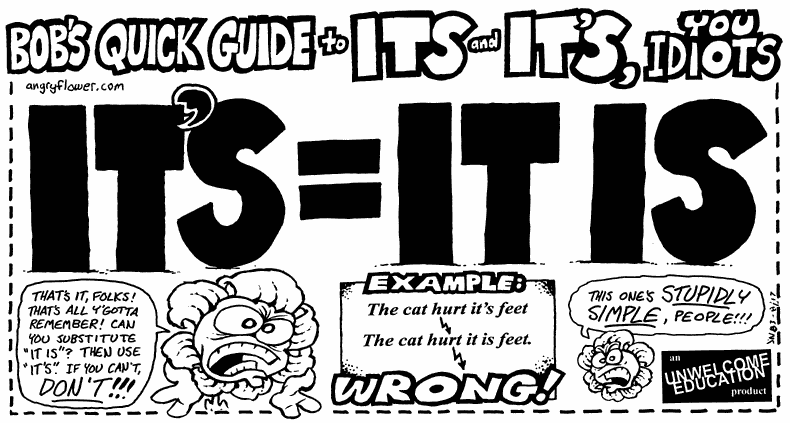
What a pity, then, that a fundamentally enjoyable game is badly flawed with simple, fixable mechanical errors that simply were not fixed. Here’s an oldie but a goodie: Bob’s Guide to Its and It’s, You Idiots. Print it out, hang it up, and avoid those mandatory deductions.

Rating: 5.0

Cheiron by Sarah Clelland and Elisabeth Polli [Comp05]

IFDB page: Cheiron
Final placement: 26th place (of 36) in the 2005 Interactive Fiction Competition

Okay, first I want to tell a little story about me that I promise will be at least marginally relevant to my experience of this game. I’m in the fifth grade, and we’re taking a class field trip to some hospital, I guess so we can learn about how hospitals work. We go to a few different places, and then are shepherded to the lab. There, a medical researcher shows us a centrifuge, and explains how they use it with blood to separate out the red blood cells, platelets, and plasma. He holds up a test tube of blood (not a sight I wanted to see), swirls it, and… next thing I know I’m looking up at a bunch of concerned faces. (And some amused ones.)

I had passed out, directly in reaction to seeing that blood swirl. Lucky me, I got to do the rest of the tour in a wheelchair, with my classmates competing for who would get to push me. That’s about how I do with medical stuff. (Ironic, given that my mom had a 43-year career as a nurse.) In fact, years later — after 9/11 — I tried to give blood, and had such an extreme reaction to the process that I was asked not to come back. So it’s fair to say I am not in the audience for a game that tries its hardest — including usage of images and sounds — to simulate the experience of being a medical student. I felt woozy and icky for much of the time I made my way through Cheiron.

That said, the fundamental premise of Cheiron is quite cool! If pilots can hone their skills through flight simulator software, maybe medicos could have training simulations too. If nothing else, this game taught me some of the initial steps in a medical consultation — greeting, wash hands, ask for consent. Or at least, those are apparently to be the steps in the UK, where this game seems to have been produced.

Unfortunately, nifty though the concept may be, the implementation is problematic, though not due to lack of effort on the part of the authors. This exchange encapsulates the experience of the game pretty well:

>take pulse
Which do you mean, the jugular venous pressure, the left dorsalis pedis pulse, the right dorsalis pedis pulse, the left posterior tibial pulse, the right posterior tibial pulse, the left popliteal pulse, the right popliteal pulse, the left femoral pulse, the right femoral pulse, the left carotid pulse, the right carotid pulse, the left brachial pulse, the right brachial pulse, the left radial pulse or the right radial pulse?

Aaah! There is a lot going on here, most of it not so good. First of all, for a lay player like myself, this disambiguation question is laughable, as it reads mostly as gibberish to me. How am I supposed to make a choice between 15 different options, none of which I know what they mean? Second, does it really make sense to offer the player 15 different options at this point? Is there any world in which it would make sense to reach around the patient’s left knee rather than using, like, the wrist? This feels like an instance where the game should have just done the obvious and not made a big deal of it, unless somehow the obvious course is not available, in which case the game could either make a challenge of figuring out how to take the pulse despite an obstacle, or defaulted to the next most obvious thing.

And yet, the inclusion of all 15 of those options is a perfect emblem of how earnestly the authors approached this game. Clearly, an enormous effort was made to provide an incredible number of options for the player, which makes a lot of sense for conversations and examinations that are meant to focus in on a diagnosis. The hints for inquiring about the patient’s history list no less than 79 topics you can query, ranging from mood to pets to vomiting to rheumatic fever. It’s incredible!

Because I’m not a medical student, I ended up using Dr. Google to try to put together diagnoses based on the information the game gave me. This actually worked pretty well! I don’t really understand much about acromegaly, but given a set of lab results and a physical exam, I can put together enough clues to come up with it on a web search. Frustratingly, though, there’s no way to validate a diagnosis in this game except to look at the answers, which lists all 4 patients’ diagnoses at once. I think it would have been fine to implement fewer conversation topics in order to make room for this kind of mechanic.

All in all, this felt like a fundamentally flawed attempt at what could be a pretty interesting educational piece, though the dizzying breadth of it (at the expense of consistency and depth) demonstrated just how difficult a task the authors had set themselves. I love them for trying, though — Cheiron is a fascinating failure that feels more worthwhile than many of the weak-tea fantasies and argumentative rants I’ve played in my Comp05 list thus far.

Rating: 6.5

Phantom: caverns of the killer by Brandon Coker [Comp05]

IFDB page: Phantom: Caverns of the Killer
Final placement: 31st place (of 36) in the 2005 Interactive Fiction Competition

Right up front this game starts sending out the red flags. There’s the fact that its title isn’t in title case. There’s the fact that the debugging verbs are left on. (Not that I remember how to use them decades later.) And then there are the opening sentences:

Legends speak, of a great egyption warrior. Who rose in the military ranks faster that any other.

So, whew, just very rough right away. I dialed my expectations down, way down, and kept playing. Here is an advantage to playing the comp games outside the comp period — it had been about 6 months since I played Dreary Lands. Consequently, my patience account had built back up, enabling me to battle through the terrible writing and nonsensical milieu, looking for some things to appreciate.

The impression I got was of a very, very young author (or at least one who hadn’t done a lot of writing or received a lot of feedback), more attuned to the programming part of IF than the writing part. This is a demanding medium, in that it requires authors to be skilled in two traditionally separate areas — prose storytelling and coherent code. Phantom has its problems with the latter (though much less so than, say, Dreary Lands), but falls down very badly on the former.

The result is a game that tries to horrify, but keeps stumbling into unintentional comedy. Horror in particular is a tough genre for an author lacking basic skills, though it’s apparently an attractive one for such authors as well — see Exhibit A, Rybread Celsius. In order for a reader to be scared or creeped out by a fictional world, she’s got to be able to suspend disbelief about that world, and under an avalanche of prose errors, it’s pretty difficult to suspend disbelief.

Another obstacle to believing in Phantom‘s world lies in the weird numbers that occasionally pepper the text. For example:

>open black box
The box opens but a hand comes out grabs your face and squeezes the blood from your veins.1

“1”? I mean, the death message is a little comical as it is, what with the way a hand to the face somehow causes circulation problems, but the “1” afterwards is clearly just a mistake, or maybe a debugging leftover. Given that there’s a “2” that appears after the winning ending, I’m guessing this has to do with the game setting Inform’s death message flag, and maybe printing it out either by mistake or as a way of making sure the right message prints, or something.

Then again, it’s not just death messages — there’s also this:

You can see a Large emerald here.
1

>x 1
(the Large emerald)
A very large finely cut emerald.

Really not sure what’s going on here, but it did give me a good chuckle.

In any case, Phantom seems like a well-intentioned attempt by someone who does not have control of his tools. I’d prescribe some intense focus on learning basic English mechanics, hopefully with instructional support, and a lot of beta-testing to root out weird code behavior, in order to produce a much improved next game. Or at least, that’s what I would have prescribed 17 years ago — I guess now I’ll just call it general advice.

Rating: 3.6

Jesus of Nazareth by Paul Allen Panks as Dunric [Comp05]

IFDB page: Jesus of Nazareth
Final placement: 33rd place (of 36) in the 2005 Interactive Fiction Competition

Between this game and Panks’ previous comp entry, Ninja v1.30, one year elapsed. Between that review and this one, the better part of 18 years has elapsed. In the interim, some things have happened, including the author’s death in 2009, just shy of his 33rd birthday.

Panks contravened many of the social norms in the IF community, and for that reason provoked reactions ranging from shunning to outright hostility. Jason Scott sums it up as well as anyone in the blog entry he wrote shortly after Panks’s death, and the comments from that entry (one of the few times I actually recommend reading the comments) flesh out the picture further.

Many things have changed technologically in those 18 years as well, which meant that I couldn’t just double-click the game file in order to run it the way I might have been able to in 2005. Jesus of Nazareth is a Windows executable, and Windows 10 wants nothing to do with it. I had to fire up a DOSBox instance to run it, and even once that succeeded there was certainly nothing like a scripting capability available, so I was reduced to taking the occasional screenshot so that I could remember notable moments in the experience of the game.

I wasn’t certain I really wanted to go through the bother, because I did not expect the game to be good, and it wasn’t. And if DOSBox had failed, I’d probably have given up. But when it succeeded, and I could at least play the game, I felt like I should at least give it a try, and in light of the author’s short and difficult life, I’m not inclined to be hypercritical.

Nevertheless, what we have here is not great. It’s a homebrewed parser game — one of Panks’ specialties — which is deeply player-unfriendly. Most anything the parser doesn’t understand (which is most things), it responds to with “You cannot do that here.”, giving a “Hello Sailor” feel to the proceedings minus any of the humor or sense of distant potential. In the very first scene, there’s a note, and if you try to read it, you’re told “You can’t make out the note.” If you type “x note” (not “X NOTE” because the parser can’t handle capital letters)… you read the note. You meet a centurion who is holding a spear, helmet, and shield. If you try to examine any of those things, you’re told, “That isn’t here.”

Technical flaws aside, the premise of this game made me smile. You play — not surprisingly — Jesus of Nazareth, and your goal is to get followers. The game knows and relies upon the command “convert”, as in “convert matthew.” The “score” command tells you this, at the beginning of the game:

Your goal is to convert at least 4 disciples to your cause.
Thus far, you have converted:
You still have 6 disciple(s) left to convert.

If you’re going to make Jesus the PC in a text adventure, this seems like a pretty logical way to keep score! On the other hand, if you’re going to make Jesus the PC in a text adventure, the parser should probably know the word “forgive”. See, I hadn’t wandered too far when I found myself trapped in a location with the aforementioned centurion, who was insisting on seeing my papers, and wouldn’t let me leave. I had no papers — no inventory at all. Talking didn’t work. Converting didn’t work. Forgiveness wasn’t even an option. And there is no walkthrough.

So I quit, and forgave the game its trespasses.

Rating: 3.5